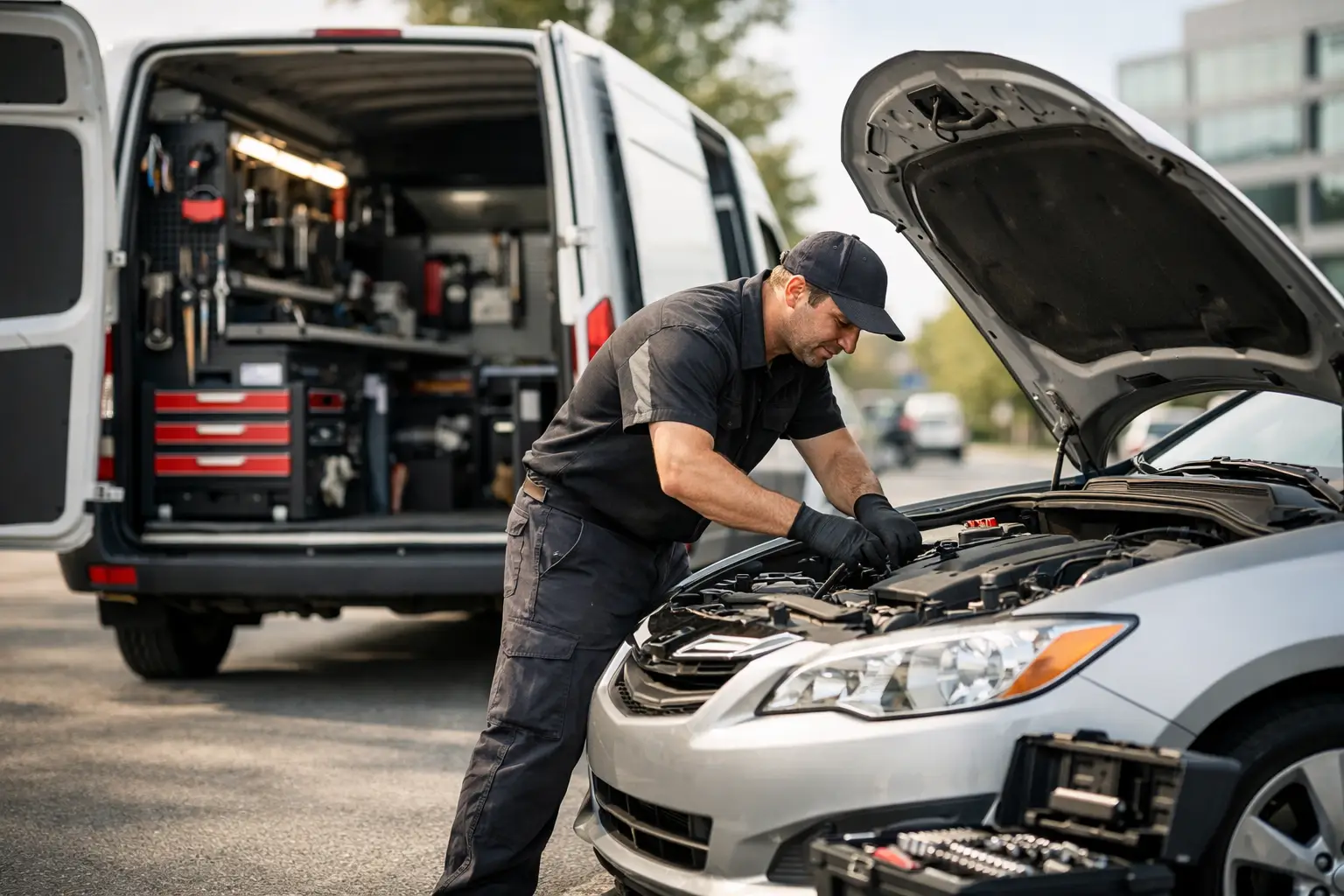
A truck that will not start at a job site is not just a repair issue. It can delay a crew, hold up materials, disrupt a schedule, and leave equipment sitting idle. Mobile car repair brings the technician to the vehicle, so routine problems and many breakdowns can be handled where the work is happening instead of adding a tow and a shop visit to the delay.
For contractors, delivery operations, service companies, and fleet owners, the value is simple: less movement, less waiting, and a faster path back to work. Mobile service is not the answer to every repair, but it is often the most practical answer when downtime is costing more than the repair itself.
What Mobile Car Repair Can Handle On-Site
Mobile repair is most effective when a vehicle can be diagnosed and repaired safely at a fleet yard, job site, customer location, roadside area, or business parking lot. A properly equipped mobile technician can handle a wide range of automotive, diesel, truck, and trailer work without requiring the vehicle to enter a shop.
Common on-site work includes no-start diagnostics, battery and charging system repairs, electrical troubleshooting, brake service, preventive maintenance, fluid leaks, engine performance concerns, cooling system repairs, trailer repairs, lift gate service, and hydraulic issues. Mobile technicians can also perform fleet inspections and DOT-related service work that helps identify problems before they become road calls.
For commercial vehicles, preventive maintenance is often the best use of mobile service. Oil changes, filters, inspections, brake checks, belt and hose inspections, and fault-code diagnostics can be completed while vehicles are parked at the yard. That means a work truck does not have to lose a half day traveling to and waiting at a repair facility.
The exact repair depends on the vehicle, the location, available parts, and the safety of the work area. Major internal engine repairs, extensive collision damage, alignment work, or repairs requiring a lift may still need a shop. A dependable mobile repair provider should be clear about that early, not promise an on-site fix that is not practical.
Why Mobile Car Repair Reduces Fleet Downtime
The repair itself is only one part of a breakdown. A vehicle that goes to a shop may need a tow, a driver or employee to manage the drop-off, time in the service queue, and another trip to retrieve it. For a work truck or delivery vehicle, every one of those steps adds lost production.
Mobile service removes much of that friction. The technician arrives at the vehicle, diagnoses the issue, and works where the vehicle is already parked. If the repair is straightforward and parts are available, the unit may return to service without leaving the site.
That matters most for businesses with vehicles that support field operations. A plumbing truck without power, a box truck with a brake issue, or a diesel work truck that will not crank can affect more than one employee. It can interrupt the entire day’s route or job schedule.
There is also a planning advantage. Fleet managers can schedule maintenance at a time when vehicles are naturally parked, such as early morning, late afternoon, or during a slower work period. Instead of rotating trucks through a shop and rearranging crews, maintenance can come to the fleet yard.
The Right Time to Call a Mobile Technician
A mobile repair call makes sense when the vehicle is disabled, unsafe to drive, difficult to move, or needed back in service quickly. It is also useful when several vehicles need maintenance at the same location. One visit can address multiple units, giving the fleet manager a clearer picture of what needs attention now and what can be scheduled later.
Call early when you notice warning signs. A slow crank, repeated battery issue, check engine light, air leak, brake noise, charging problem, coolant loss, or intermittent electrical fault can become a roadside breakdown if it is ignored. Waiting until a truck is fully down usually limits options and increases cost.
For diesel and commercial equipment, early diagnostics are especially valuable. Fault codes, emissions issues, DPF concerns, sensor failures, and electrical problems do not always stop a vehicle immediately. They can still reduce performance, cause derates, or turn into a no-start condition at the worst possible time.
When contacting a mobile repair provider, have the vehicle year, make, model, VIN if available, engine type, location, and a clear description of the issue ready. If warning lights are present, note the messages or fault codes. This information helps the technician arrive prepared and reduces time spent identifying basic details.
Mobile Repair Is Not Just for Large Fleets
Large fleets benefit from organized maintenance programs, but small operations often have the most to gain from mobile service. A company with one service truck may not have a backup unit. When that vehicle is down, the owner may be unable to reach customers, haul tools, or complete scheduled work.
The same applies to personal vehicles that support a business. If the owner’s pickup pulls a trailer, carries job materials, or serves as the daily transportation between sites, it is a working asset. Mobile automotive repair can save time when taking the vehicle to a shop would mean losing a day of work.
For larger fleets, the priority is consistency. A mobile maintenance schedule helps track recurring issues, identify vehicles that need attention, and keep basic service from being postponed until it creates a failure. The goal is not to repair everything at once. It is to keep the fleet reliable and make repair decisions before a breakdown dictates the schedule.
What to Expect From a Professional Mobile Repair Visit
A productive service visit starts with a clear inspection and diagnosis. Replacing parts before confirming the cause of a problem wastes time and money, especially with electrical and engine-performance issues. The technician should explain what was found, what repair is recommended, and whether the vehicle can safely remain in service.
For fleet work, documentation matters. Service records help managers track maintenance history, recurring faults, repairs completed, and units that may need future attention. That information supports better scheduling and prevents the same concern from being diagnosed repeatedly without addressing the underlying cause.
Parts availability can affect the timeline. Many common repairs can be handled quickly, but specialized diesel, emissions, hydraulic, trailer, or lift gate components may need to be sourced. A good mobile repair process sets realistic expectations: what can be completed now, what requires parts, and whether the vehicle should be held out of service.
Safety also comes first. Roadside and job-site repairs must be performed in a workable area with enough room for the technician and vehicle. If traffic, unstable ground, active equipment, or site conditions create a risk, moving the vehicle or arranging a different service location may be necessary.
A Better Maintenance Plan Starts Where Your Vehicles Park
For businesses across the Florida Panhandle, from Mexico Beach through Fort Walton Beach, mobile service can turn routine vehicle care into a scheduled operation instead of an emergency. A fleet yard, contractor shop, staging area, or job site can become the place where inspections and repairs happen with less interruption to the workday.
The strongest approach is to separate urgent repairs from planned maintenance. Handle safety issues and breakdowns immediately, then schedule the oil services, inspections, brake checks, electrical testing, and trailer work that prevent the next unexpected stop. That gives owners and fleet managers more control over labor, vehicles, and job schedules.
A vehicle does not need to be completely disabled before it deserves attention. Address the small warning signs while the truck is still parked, accessible, and available for service. That is usually the lowest-cost moment to keep it working.
