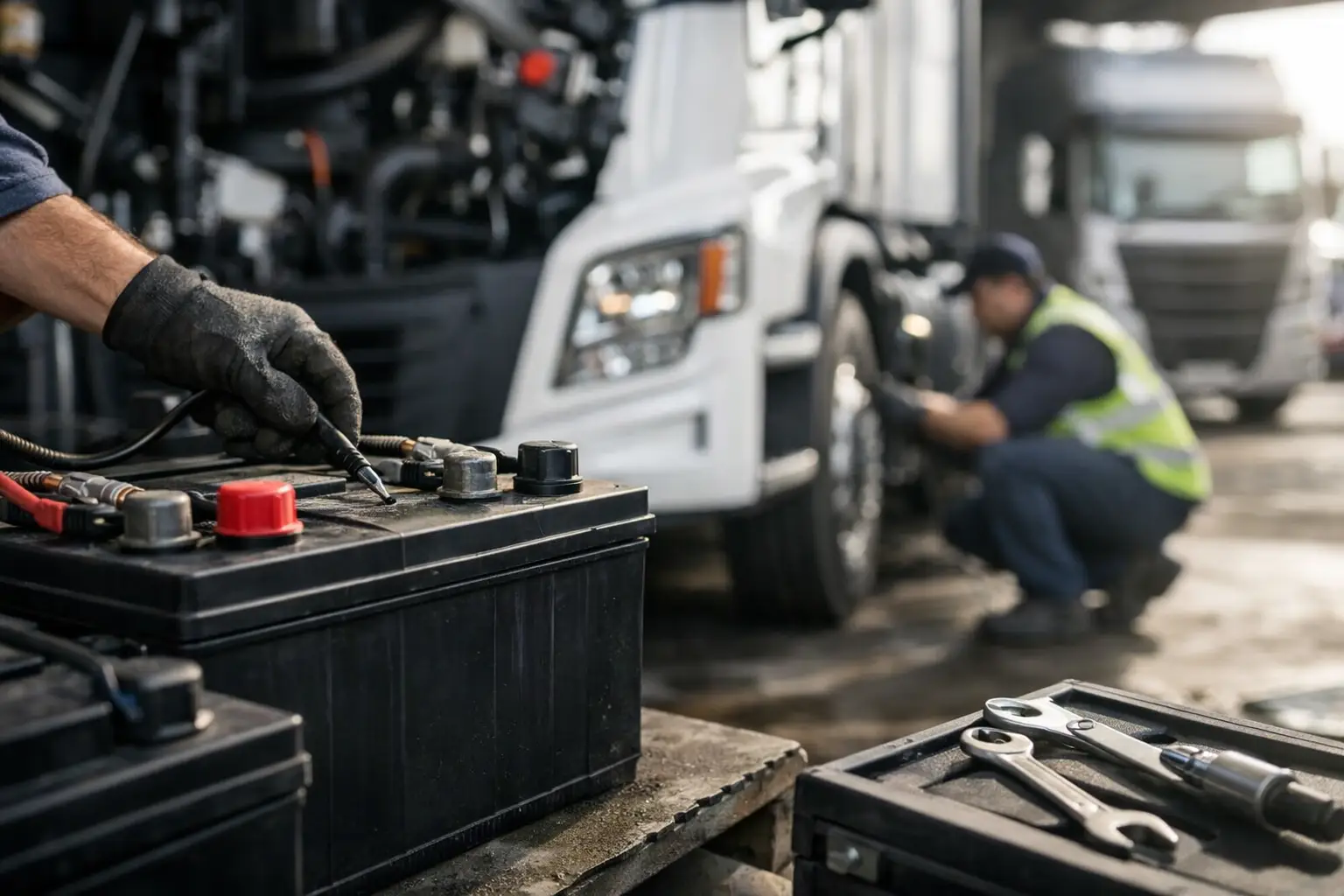
A truck that will not crank at the start of a shift can sideline a crew, delay deliveries, and turn a simple service call into a lost workday. Truck batteries are easy to overlook because they usually work without attention - until heat, corrosion, repeated short trips, or an electrical draw exposes a weak battery at the worst possible time.
For commercial trucks, service vehicles, box trucks, and diesel equipment, battery reliability is not just a maintenance detail. It is part of keeping the operation moving. A practical battery program helps catch problems at the yard instead of on the roadside or at a job site.
What Truck Batteries Have to Handle
Truck batteries do more than start the engine. They supply the high current needed to crank a diesel engine, support lighting and accessories before the engine starts, and help stabilize voltage for modern electrical systems. On many heavy-duty trucks, multiple batteries are connected together to provide more cranking power and reserve capacity.
That setup means one weak battery can affect the entire system. A truck may crank slowly, show intermittent electrical issues, or fail to start even when the other battery appears serviceable. Replacing one battery in a mismatched pair can also create problems if the remaining battery is older or has reduced capacity. The new battery may be forced to carry more of the load and wear out early.
Starting batteries are designed to deliver a strong burst of current. Deep-cycle batteries are designed to handle repeated discharge and recharge cycles. Some work trucks need both capabilities because they run lift gates, inverters, work lights, refrigeration equipment, hydraulic systems, or other accessories. The right battery depends on the truck's electrical load and how it is used, not just whether it fits in the battery box.
Why Truck Batteries Fail in Working Fleets
Battery age matters, but it is rarely the only reason a battery fails. Florida heat can shorten battery life by accelerating internal chemical breakdown and increasing water loss in serviceable batteries. A battery that survives several years in a cooler climate may have a much shorter useful life in a Gulf Coast fleet.
Repeated short trips create another common issue. If a truck starts several times a day but does not run long enough for the alternator to restore the energy used during cranking, the batteries remain undercharged. Over time, chronic undercharging causes sulfation on the battery plates. That reduces available capacity, even if the battery still shows a normal voltage reading at rest.
Vibration is especially hard on trucks and equipment used on job sites. Loose hold-downs, damaged battery trays, and rough operating conditions can damage internal battery connections. Corroded terminals and poor grounds add resistance, which limits charging and cranking performance. A battery may test weak when the actual issue is a bad cable, loose terminal, failing ground strap, or charging-system problem.
Parasitic draw can also drain a healthy battery while the vehicle is parked. Dash cameras, GPS units, lift gate controls, aftermarket accessories, interior lights, faulty modules, and improperly installed equipment can all draw power after shutdown. If a truck needs a jump after sitting overnight or over a weekend, testing for excessive draw should be part of the diagnosis.
Warning Signs to Address Before the Truck Stops
A slow crank is the most obvious warning sign, but battery trouble is not always that clear. Watch for dim or flickering lights, intermittent dash warnings, accessories that reset, clicking during a start attempt, or a truck that starts normally one day and struggles the next. On diesel trucks, cold-start issues can appear earlier because high compression engines require more cranking power.
Swollen battery cases, cracked housings, leaking electrolyte, and heavy corrosion are immediate service concerns. Do not assume corrosion is only cosmetic. Terminal buildup can create enough resistance to reduce starting power and interfere with proper charging. Cleaning the terminals may help, but the technician should also determine why corrosion is recurring. Overcharging, loose connections, battery damage, and improper terminal protection can all contribute.
A battery warning light does not automatically mean the battery is bad. That light often points to a charging-system issue involving the alternator, belt, wiring, or voltage regulator. Replacing batteries without checking charging voltage can waste money and leave the original problem unresolved.
How to Test Truck Batteries Correctly
A voltage check is useful, but it is only the first step. A fully charged 12-volt battery should generally read around 12.6 volts at rest. A lower reading may indicate a discharged battery, but it does not confirm whether the battery can still carry a load. A battery with damaged plates can show acceptable voltage and still fail during cranking.
A proper inspection starts with the physical condition of the battery, terminals, cables, grounds, tray, and hold-down hardware. The batteries should then be tested for state of charge, available cold cranking amps, and overall condition. On trucks with multiple batteries, each battery should be tested individually. Testing only the combined system can hide a weak unit.
The charging system should be checked with the engine running and under electrical load. The alternator must provide enough voltage to recharge the batteries without overcharging them. A weak alternator can leave batteries undercharged; an overcharging condition can overheat and damage them. If batteries repeatedly fail sooner than expected, the charging system and key-off electrical draw need attention.
For fleet owners, battery testing should be scheduled rather than performed only after a no-start. Testing before peak summer heat, before seasonal demand increases, and during preventive maintenance gives a clearer picture of which units are approaching replacement. Recording test results by vehicle also helps identify patterns, such as a specific route, accessory package, or truck model that is harder on batteries.
Charging, Replacement, and Battery Matching
Charging a deeply discharged truck battery is not always the same as fixing it. If the battery has been left dead for an extended period, its capacity may be permanently reduced. A charger can restore voltage temporarily, but a load test determines whether the battery is dependable enough for service.
When replacement is needed, match the battery group size, terminal configuration, cold cranking amp rating, reserve capacity, and application requirements. Installing a lower-capacity battery because it is available can create repeat starting problems, particularly on diesel trucks or trucks with high accessory loads.
On a two-battery system, replacing batteries as a matched pair is often the best choice when both are the same age and have worked together for several years. There are exceptions. If one battery was recently replaced and the other was damaged by a separate issue, replacing only the failed unit may be reasonable. The decision should be based on individual test results, battery age, and the condition of the charging system.
Avoid mixing battery types, capacities, or significantly different ages in the same connected bank whenever possible. Uneven batteries charge and discharge differently, which can shorten service life and make electrical problems harder to diagnose.
A Practical Fleet Battery Routine
A dependable battery routine does not need to slow down the operation. During regular vehicle service, technicians can inspect terminals, confirm hold-downs are secure, check cables and grounds, and test battery health. Trucks that sit for long periods need special attention because inactivity can allow batteries to discharge gradually.
Drivers can help by reporting slow starts immediately instead of waiting for a complete failure. They should also avoid leaving unnecessary accessories on after shutdown and make sure battery compartments are closed and protected from moisture and debris. For trucks with frequent idle time, short routes, or high accessory use, the maintenance schedule may need more frequent battery and charging-system checks.
Mobile Fleet Services can perform on-site battery, cable, and charging-system diagnostics for commercial vehicles across the Florida Panhandle. That allows fleet managers to address weak batteries where the truck is parked or working, rather than waiting for a roadside no-start.
When a Truck Needs a Jump Start
A jump start can get a truck moving, but it should not be treated as the repair. If the vehicle starts after a jump, it still needs to be checked for battery condition, alternator output, connection problems, and excessive draw. Continuing to run a truck with weak batteries can lead to another no-start at a customer location, job site, fuel stop, or loading dock.
If the battery case is swollen, cracked, leaking, or hot, do not attempt to charge or jump it. Those conditions can create a safety risk and require proper battery replacement. Also use the correct jump-start procedures for the truck's voltage and battery configuration. Heavy-duty vehicles may have different requirements than standard passenger vehicles.
The best battery repair is the one completed before the first failed start of the day. Consistent inspections, accurate testing, and timely replacement keep trucks available for the work they were purchased to do.
