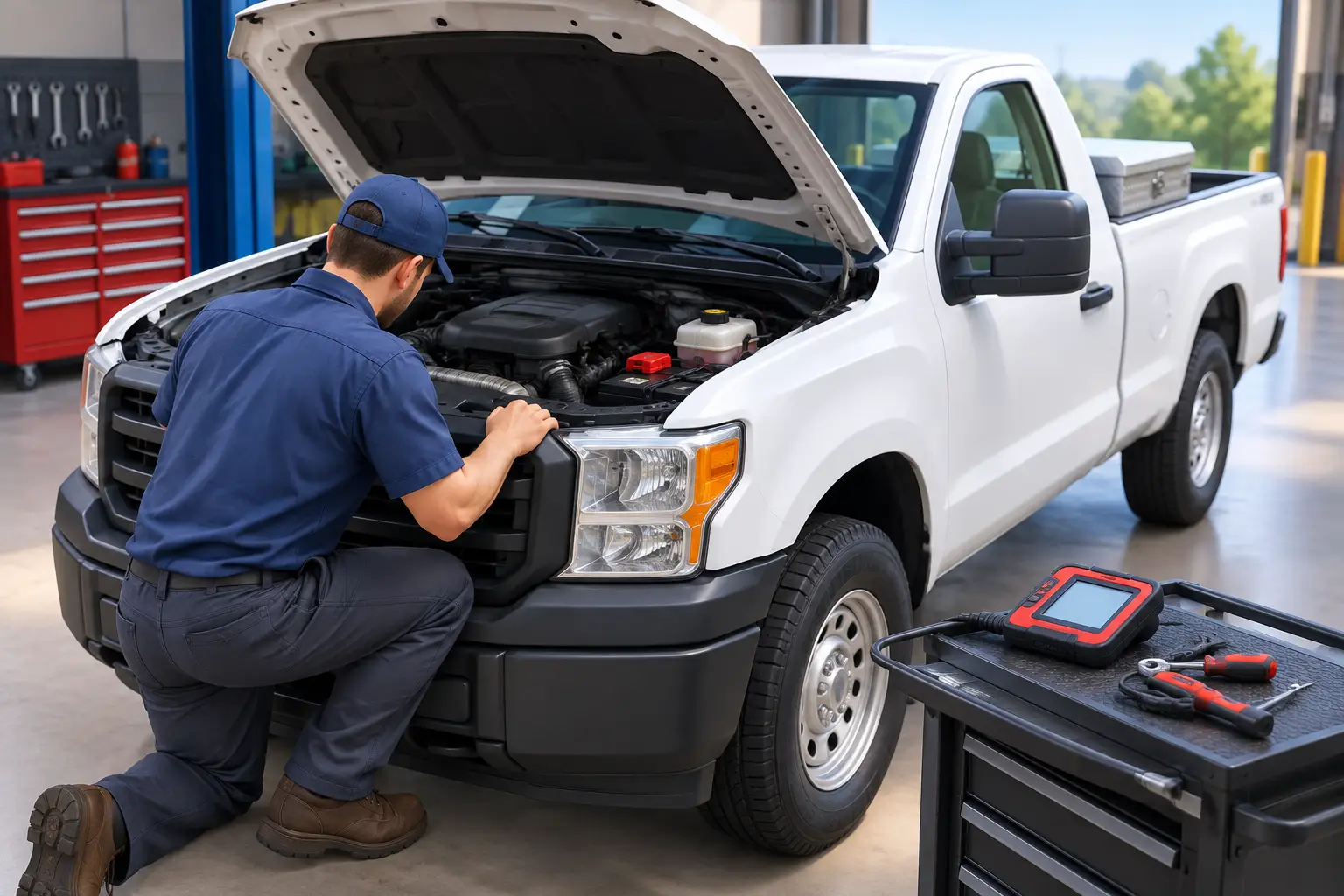
A work truck that will not start can stop a crew before the day begins. Before scheduling changes, sending someone for parts, or calling for a tow, take a few minutes to troubleshoot work truck starting problems in the right order. The symptoms usually point toward the system at fault, and a quick, safe check can prevent wasted time and unnecessary repairs.
The key is to separate a no-crank condition from a cranks-but-won't-start condition. They sound similar from the driver's seat, but they lead to very different diagnostic paths.
Start With the Exact Symptom
When the key is turned or the start button is pressed, listen and watch closely. If the engine does nothing, clicks once, clicks repeatedly, or cranks slowly, begin with the battery, cable connections, grounds, and starting circuit. If the engine cranks at normal speed but does not fire, look toward fuel delivery, air, engine sensors, immobilizer issues, or diesel emissions-related faults.
A rapid clicking sound usually means the starter is not receiving enough current. A single heavy click can indicate a weak battery, damaged cable, poor ground, or a starter solenoid that is engaging but not turning the engine. No sound at all may point to a neutral safety switch, clutch switch, blown fuse, relay, ignition switch issue, or an electrical control problem.
If the truck starts after a jump but dies again later, do not assume the battery is the only problem. The charging system may not be replenishing the battery, or there may be a parasitic draw while the truck is parked. Both problems can repeatedly take a vehicle out of service.
Check the Battery Before Replacing Parts
Battery problems are common, especially in trucks that sit overnight, run multiple accessories, or work in humid and hot Florida conditions. Heat can shorten battery life, and corrosion builds faster around terminals exposed to moisture and road grime.
Begin with a visual inspection. Look for loose terminal clamps, green or white corrosion, swollen battery cases, broken hold-downs, and damaged cables. A battery that can move in its tray can damage terminals internally and create intermittent no-start problems.
Clean corrosion only with the truck shut down and proper protective equipment in place. Make sure the terminal connections are tight after cleaning. A terminal can look connected while still failing under the high electrical load required to crank a diesel engine.
Voltage alone does not tell the whole story. A battery can show an acceptable resting voltage yet fail when the starter draws current. Load testing is the better check, particularly on a diesel work truck with dual batteries. In a dual-battery setup, one weak battery can pull the other down and create slow cranking, even when the other battery appears healthy.
Also inspect the main grounds. Check the negative battery cable connection, the engine block ground, and the chassis ground. A corroded or loose ground can mimic a failed starter, failed battery, or electrical module fault.
Avoid Extended Cranking
Do not crank the engine continuously in hopes that it will eventually start. Long crank cycles overheat the starter, drain the batteries, and can make a basic repair more expensive. Use short attempts, then pause and reassess what the truck is doing.
For diesel trucks, repeated cranking can also complicate diagnosis by masking a fuel supply issue or creating low-voltage faults in the vehicle's control modules.
Inspect Cables, Fuses, and Starting Controls
Battery cables carry high current, so damage that is hidden beneath insulation matters. Look for stiff cable sections, rubbed-through insulation, melted spots near the exhaust, loose lugs, and corrosion traveling under the cable covering. On older service trucks, cable damage often develops where the harness flexes or where auxiliary equipment was added.
Next, check the relevant fuses and relays. The owner's manual or fuse-box cover can identify the starter relay, ignition circuit fuse, ECM power fuse, and fuel system fuses. A blown fuse should not simply be replaced and ignored. If it blows again, there is likely a short, overloaded circuit, or component failure that needs to be located.
Automatic trucks should be firmly in Park. If they do not start, try Neutral with the brake applied. A worn or misadjusted neutral safety switch can prevent starter engagement. On manual transmissions, make sure the clutch pedal is fully depressed. A failed clutch safety switch can produce a complete no-crank condition.
Modern work trucks also rely on communication between several modules. A security light, warning message, or no-start after a key replacement may indicate an immobilizer or programming issue. This is not a situation for bypassing safety systems. Proper diagnostics are needed to verify the fault without creating a larger electrical problem.
If It Cranks but Will Not Start
A truck that cranks normally has enough starter engagement to turn the engine, but it still needs the correct fuel, air, compression, timing, and electronic control to run. For gasoline trucks, fuel pump operation and ignition faults are common possibilities. For diesel trucks, low fuel supply pressure, air entering the fuel system, contaminated fuel, failed sensors, and emissions-related derates can all contribute.
Check the fuel level first, even if the gauge indicates there is fuel. Faulty level sensors are more common than many operators expect. On diesel equipment, verify that fuel shutoff valves are open and that no recent service work left a connector loose or introduced air into the system.
If a fuel filter restriction indicator is present, inspect it. A plugged fuel filter can cause hard starting or a crank-no-start condition, especially under load after the truck has been running. Water contamination is another concern. Drain water separators according to the truck manufacturer's procedure and do not ignore water-in-fuel warnings.
Pay attention to the exhaust and dash messages. A diesel truck with active DPF, DEF, or emissions-system faults may have starting limitations or reduced performance depending on the vehicle and fault severity. Guessing at sensors or attempting to clear codes without diagnosing the cause can turn a manageable repair into a repeat breakdown.
Use Scan Data Instead of Guesswork
A scan tool is often the fastest way to narrow down a starting issue on a late-model work truck. Diagnostic trouble codes provide direction, but they are not automatic proof that a named part has failed. For example, a low-voltage code may be caused by a bad battery connection, while a fuel pressure code may result from a restriction, air leak, wiring problem, or failed component.
Useful live data can include battery voltage during crank, engine RPM while cranking, fuel rail pressure, commanded versus actual fuel pressure, coolant temperature, crankshaft position signal, and immobilizer status. On diesel trucks, this information helps determine whether the engine control module is seeing the conditions required to command fuel injection.
This is where a professional diagnostic process saves money. Replacing a starter, batteries, injectors, or fuel pumps based only on a symptom can be expensive. Testing the circuit, confirming the failure, and checking related systems is usually faster than replacing parts one at a time.
When a Mobile Technician Makes Sense
Some starting problems can be resolved at the yard with a cleaned battery connection, charged battery, replaced relay, or simple fuel-system correction. Others require testing equipment, wiring diagrams, scan data, and experience with commercial vehicle systems.
Call for service when the truck has repeated dead batteries, visible cable damage, a no-crank condition with good batteries, fuel or DEF warnings, active engine fault messages, or a crank-no-start problem that does not have an obvious cause. This is especially true when the truck is blocking a job site, loaded for delivery, or assigned to a crew that cannot wait at a repair shop.
Mobile Fleet Services can perform on-site electrical diagnostics, diesel repair, fleet maintenance, and starting-system repairs across the Florida Panhandle. Bringing diagnostics to the truck can reduce towing delays and help get a work vehicle back into service where it is needed.
A work truck rarely fails at a convenient time. Document the exact symptom, protect the batteries from repeated cranking, and address small electrical or fuel-system warning signs before they become a lost day for the entire crew.
