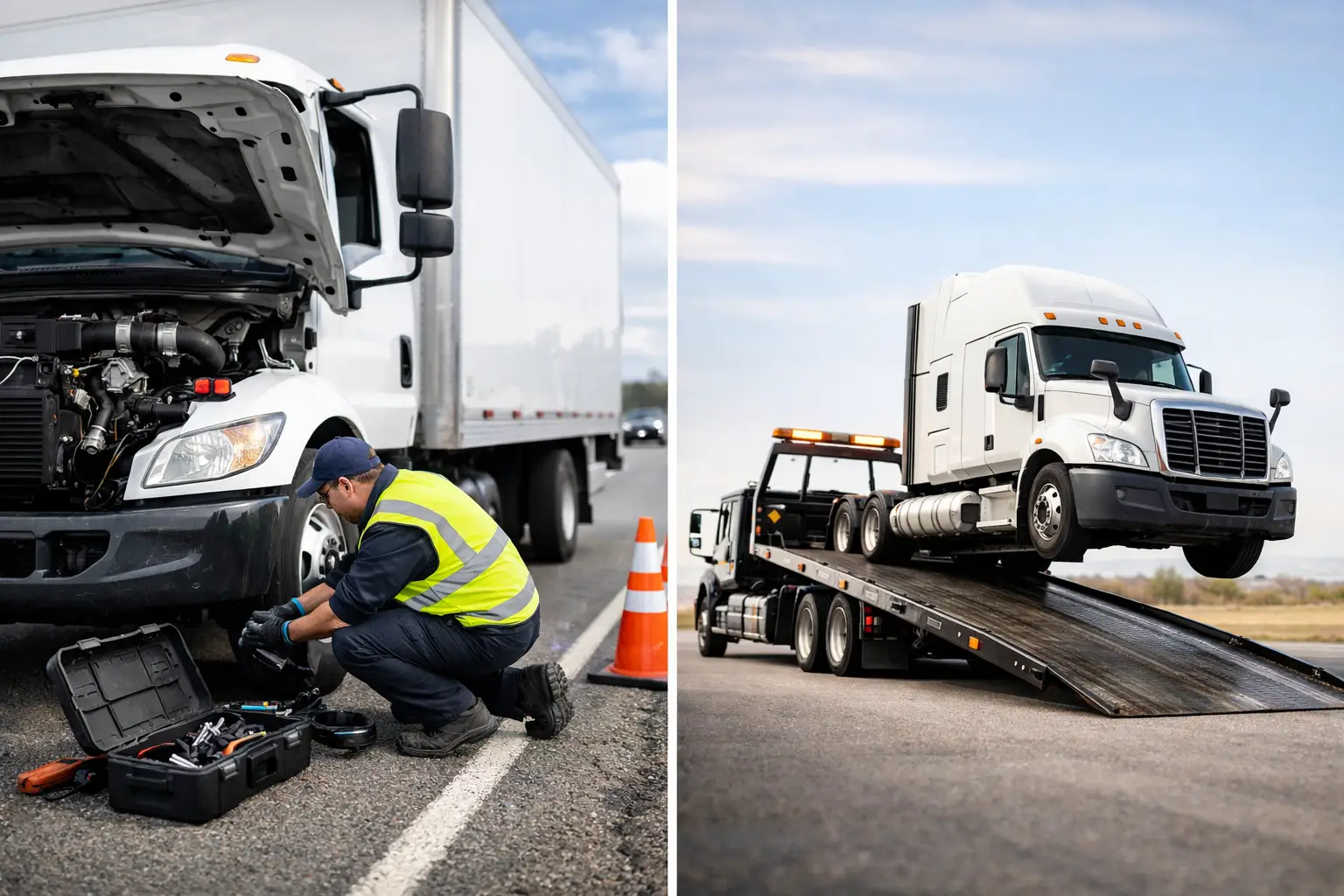
A disabled work truck on the shoulder, a box truck stalled at a delivery stop, or a trailer with brake trouble at a job site creates the same immediate problem: work stops. In the roadside repair versus towing decision, the cheapest option is not always the one with the lowest invoice. The right choice is the one that safely gets the vehicle back to productive work with the least total downtime.
For contractors, fleet managers, owner-operators, and delivery businesses, that decision often needs to be made quickly. A mobile repair can eliminate a tow, avoid a shop wait, and get a vehicle moving the same day. But some failures require controlled transport to a shop. Knowing the difference protects your drivers, equipment, schedule, and bottom line.
When Roadside Repair Makes Business Sense
Roadside repair is a strong option when the issue can be diagnosed, repaired, and tested safely where the vehicle sits. A qualified mobile technician brings tools, diagnostic equipment, and common repair parts directly to the roadside, fleet yard, job site, or customer location. There is no need to coordinate a tow, unload cargo, move attached equipment, or wait for a shop bay to open.
Many breakdowns are caused by problems that are repairable on-site. Electrical faults, starting and charging issues, damaged wiring, loose connections, air leaks, minor fuel delivery problems, brake adjustments, lighting failures, trailer issues, lift gate problems, and certain sensor-related faults may be resolved without moving the vehicle first.
The value is greater than avoiding a tow bill. A work truck that can be repaired in a parking lot may make its next appointment. A semi-truck repaired at a fleet yard may avoid a missed load. A contractor can keep a crew and equipment on the job instead of sending another employee to retrieve a disabled vehicle.
Roadside service also reduces secondary disruption. Towing a loaded box truck or a truck with a trailer can require extra coordination, create cargo concerns, and add hours before repairs even begin. If the repair is straightforward and the vehicle can be safely tested after the work is complete, mobile service is often the faster operational decision.
Common Repairs That May Be Handled On-Site
The exact repair depends on the vehicle, fault, location, and available parts. Still, mobile repair is commonly appropriate for issues such as dead batteries, alternator failures, starter problems, no-start diagnostics, electrical and lighting faults, air system leaks, minor brake concerns, damaged trailer wiring, lift gate malfunctions, hydraulic hose or connection problems, and certain emissions or sensor diagnostics.
Preventive repairs also belong in this category. A technician can perform inspections, fluid services, brake checks, DOT-related repairs, and scheduled maintenance at your yard or job site. That keeps trucks from becoming roadside emergencies in the first place.
When Towing Is the Safer Choice
Towing is necessary when driving the vehicle could create a safety hazard, cause major damage, or prevent an accurate repair. It is not a failure of the roadside service process. It is the correct next step when the repair requires a lift, specialized shop equipment, extensive disassembly, or a controlled work environment.
A truck with severe engine damage, major coolant loss, a failed transmission, structural damage, a wheel-end failure, or significant collision damage should not be pushed back into service. The same applies when a vehicle cannot brake, steer, or maintain safe operation. Continuing to drive can turn a repairable failure into a much larger repair, or worse, put the driver and other motorists at risk.
Towing may also make sense when the breakdown location is unsafe. A narrow shoulder, active traffic lane, unstable job site, poor visibility, or severe weather can limit what can be done roadside. A good repair decision starts with the safety of the driver, technician, and public.
Some diesel and emissions faults require more than clearing a code or replacing a sensor. If diagnosis points to internal engine damage, a DPF system issue requiring specialized equipment, or a failure that cannot be verified outside a shop, towing to the proper facility prevents repeat downtime.
Roadside Repair Versus Towing: What to Consider First
The best decision is based on the condition of the vehicle, not guesswork. Before authorizing a tow or calling for mobile repair, gather clear information from the driver. A few minutes of accurate details can prevent sending the wrong service response.
Consider these five factors:
- Safety: Can the vehicle be parked securely and repaired without exposing people to traffic, unstable ground, or other hazards?
- Driveability: Does it have safe steering, braking, tires, lighting, and enough mechanical integrity to be tested or moved after repair?
- Severity: Is the issue likely electrical, air, fuel, brake, hydraulic, or a minor mechanical problem, or does it suggest internal engine, transmission, or structural damage?
- Location: Is the vehicle at a fleet yard, job site, customer location, or safe roadside area where a mobile technician can work effectively?
- Time impact: Will towing, shop intake, and waiting for a bay take longer than an on-site diagnosis and repair?
Drivers should report warning lights, unusual noises, leaks, smoke, loss of power, brake feel, and whether the vehicle can start or move. Photos of the instrument panel, damaged components, or fluid leaks can help a technician prepare before arriving. For fleet managers, keeping unit numbers, VIN information, engine details, and maintenance history organized speeds up the process further.
Do Not Let a Warning Light Make the Decision Alone
A warning light does not automatically mean a tow is required. Many fault codes identify sensor, wiring, voltage, or emissions-related issues that need diagnosis before anyone can determine the correct repair. On the other hand, a vehicle with no warning light can still have a dangerous mechanical issue.
The key question is whether the vehicle is safe to operate and whether the problem can be confirmed and repaired where it is located. A professional diagnosis prevents unnecessary towing while also preventing unsafe decisions based on assumptions.
The Hidden Cost of Sending Every Breakdown to a Shop
Towing every disabled vehicle may seem like the cautious default, but it can quietly raise operating costs. The tow charge is only the first expense. There may be a wait for the tow truck, a delay at the repair facility, administrative time, driver downtime, missed customer commitments, rental vehicle costs, and lost crew productivity.
For a contractor, one down service truck can affect more than one employee. If the truck carries tools, materials, or specialized equipment, the entire crew may be delayed. For a delivery company, a disabled truck can force route changes and late deliveries. For an owner-operator, every non-billable hour matters.
That does not mean every repair should happen roadside. It means fleets should evaluate the full downtime cost before automatically choosing a tow. In many cases, a mobile technician can diagnose the issue quickly and give a clear recommendation: repair it on-site, make a temporary repair to move it safely, or arrange towing because shop work is required.
Build a Better Breakdown Response Plan
The most effective fleets do not wait for a breakdown to decide how they will respond. They create a simple process for drivers and dispatchers. Drivers need to know when to stop immediately, how to secure the vehicle, what information to report, and who to call. Dispatch needs a reliable way to document the problem and authorize service without delays.
Preventive maintenance is part of that plan. Regular inspections of batteries, charging systems, brakes, tires, hoses, lights, trailer connections, and fluids catch common roadside failures before they take a truck out of service. Mobile fleet maintenance is especially useful when pulling vehicles from a job site or yard to a shop would disrupt the workday.
For businesses operating from Mexico Beach through Fort Walton Beach and along the Panama City area, Mobile Fleet Services can provide on-site diagnostics and repair for commercial trucks, trailers, work vehicles, and fleet equipment. The goal is simple: determine what can be fixed where it sits, and be direct when towing is the safer answer.
A breakdown will always be inconvenient. The response does not have to create a full day of lost production. Choose roadside repair when it is safe and practical, choose towing when the vehicle needs it, and treat every service call as an opportunity to get the equipment back to work with less delay next time.
