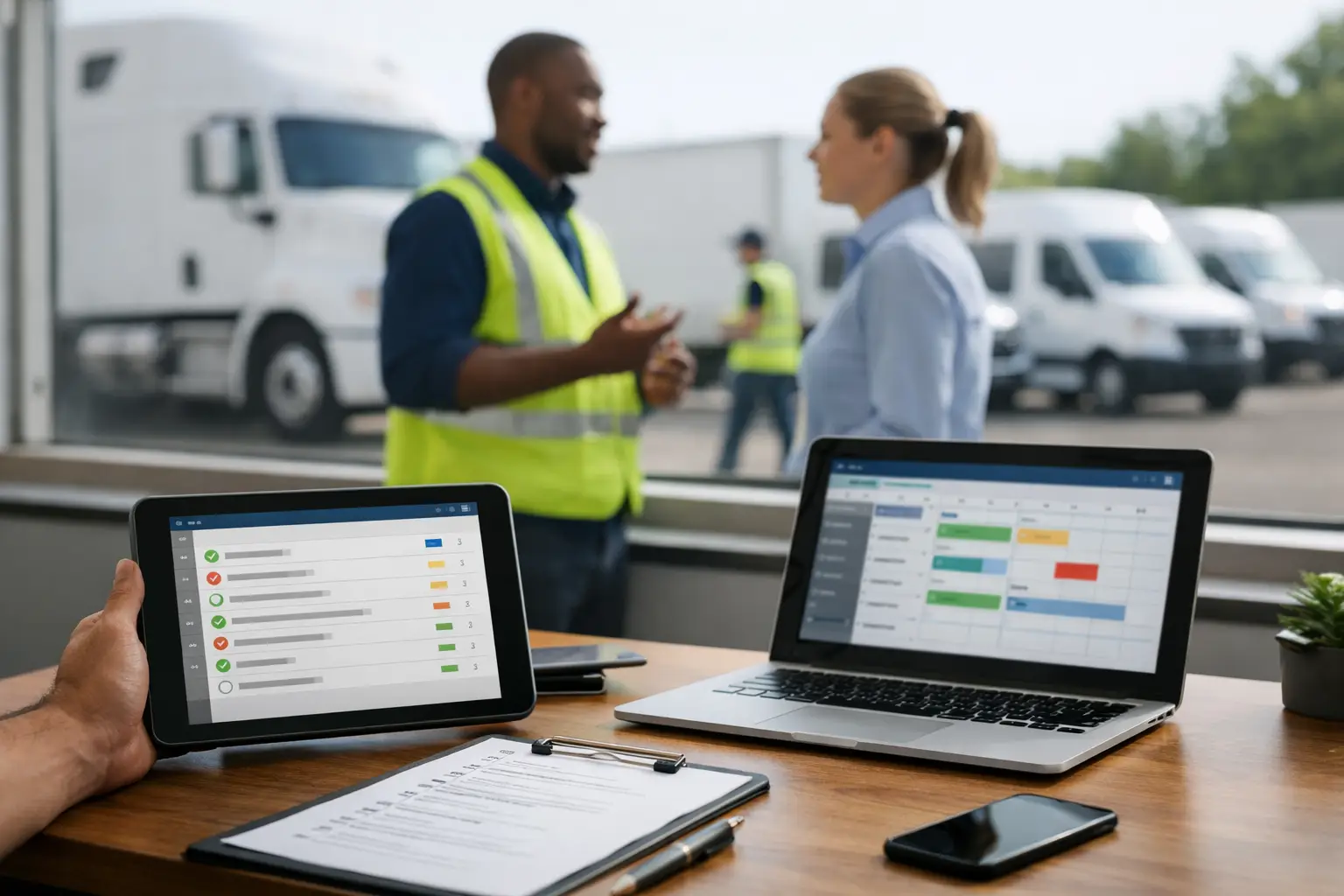
A work truck that misses a morning inspection can become a roadside call by lunch. A trailer with an unreported light issue can fail a DOT inspection. A service request that stays in one employee's text messages can leave a crew waiting at a job site with no clear answer.
Daily task tracking for teams gives fleet operators one clear view of the work that has to happen before vehicles, equipment, and people start losing time. It is not about adding paperwork. It is about making sure inspections, repairs, driver reports, maintenance appointments, and follow-up work are assigned, visible, and completed.
For contractors, delivery businesses, transportation companies, and municipal fleets, the goal is simple: catch small issues early and keep vehicles available for work.
Why daily work gets missed in fleet operations
Most fleet teams already have a way to communicate. Drivers call. Supervisors text. A technician writes notes on a work order. The problem is that these updates are often scattered across phones, whiteboards, notebooks, and memory.
That system can work when there are two vehicles and one person making every decision. It gets unreliable as the fleet grows, jobs move between sites, or multiple people need to respond to the same issue. A driver may report a brake concern at 6:30 a.m., but the person scheduling repairs may not see it until the end of the day. Meanwhile, the truck is dispatched again because nobody can see that it has been flagged.
Missed daily tasks are rarely caused by employees not caring. More often, the work was never clearly assigned, there was no due time, or nobody could confirm whether it was done. A useful tracking process removes those gaps.
Daily task tracking for teams starts with the right work
Not every item belongs on a daily task list. If the list becomes a long collection of every possible responsibility, people stop using it. Focus on the work that affects safety, compliance, vehicle availability, customer commitments, and job-site productivity.
For a fleet, daily tracked work usually falls into four areas:
- Pre-trip and post-trip vehicle inspections
- Driver-reported defects and new repair concerns
- Scheduled maintenance and inspection deadlines
- Dispatch, parts, vendor, or repair follow-up items
Each task should answer a few practical questions: What needs to be done? Which vehicle or piece of equipment is involved? Who owns the next step? When is it due? What does completed look like?
A note that says, “Truck 12 needs looked at,” is not enough. A better task says, “Truck 12 - inspect low air pressure warning reported by driver. Assigned to maintenance. Remove from dispatch if warning remains active. Due before 10:00 a.m.” The second version gives the team a decision point and makes the work traceable.
Use vehicle numbers, not vague descriptions
A fleet task should be tied to a unit number, trailer number, equipment ID, or license plate whenever possible. “Fix the box truck” creates confusion if there are several similar vehicles. “Unit B-14 - check passenger-side lift gate hydraulic leak” tells the technician and fleet manager exactly where to start.
This also helps identify repeat problems. If Unit B-14 appears in the task log several times for lift gate issues, the team can decide whether a repair is needed before the truck loses another day of service.
Assign one owner for every task
Shared responsibility often becomes no responsibility. A task can involve a driver, dispatcher, supervisor, technician, and outside repair provider, but one person should own the next action.
The owner does not have to perform every part of the work. A fleet manager may own scheduling a repair, while a mobile technician handles the diagnosis and repair. A dispatcher may own keeping an unsafe truck off the route until the repair is confirmed. The important part is that everyone can see who is responsible for moving the issue forward.
Clear ownership also prevents technicians from being pulled in too many directions. When every repair request arrives as an urgent verbal interruption, planned preventive maintenance gets delayed. That delay creates more breakdowns, which creates more interruptions. Daily tracking helps the team separate true emergencies from work that can be scheduled without disrupting the entire day.
Build a daily rhythm around the fleet schedule
The best tracking process matches how the operation actually works. A delivery fleet that leaves before sunrise needs a review before dispatch. A construction company may need a midmorning check once crews arrive at different sites. A company with night operations may need a handoff between shifts.
A short daily review is usually more effective than a lengthy meeting. Review what is overdue, what is due today, what has taken a vehicle out of service, and what needs a decision. If a truck needs parts, decide whether it can safely stay in service, whether another unit can cover the route, and when the repair will happen.
The review should not become a discussion of every open item. Keep it focused on work that affects today's operation. Lower-priority tasks can remain visible without taking attention away from a no-start condition, brake concern, fluid leak, failed light, or required inspection.
Make status updates simple enough to use
If updating a task takes several steps, people will skip it when the day gets busy. Use straightforward statuses such as new, assigned, waiting on parts, scheduled, completed, and needs follow-up.
Photos can help when a driver reports visible damage, tire wear, a fluid leak, or trailer door issue. A short description and a clear photo often give a technician enough information to bring likely parts or tools to the site. That can reduce the time between the first report and the repair.
Still, a photo does not replace a proper diagnosis. The task should show what was reported, what was inspected, what was found, and what action was taken. This matters when the same issue returns or when the fleet manager needs to understand why a unit was down.
Track preventive maintenance with the same discipline
Breakdown repairs get attention because the vehicle is already unavailable. Preventive maintenance is easier to postpone because the truck still runs. That is exactly why maintenance tasks need to be visible every day.
Oil services, brake inspections, filters, DPF-related service, cooling-system checks, trailer inspections, lift gate service, and DOT preparation should not depend on someone remembering a date. Track the service trigger, whether it is mileage, engine hours, calendar time, or a specific inspection finding.
The trade-off is real. Pulling a truck from service for maintenance may affect today's schedule. Letting service go overdue may create a larger repair, an unsafe condition, or an unplanned breakdown later. Daily tracking gives managers the information to make that choice intentionally instead of discovering the problem after a vehicle is down.
For fleets spread across job sites in the Florida Panhandle, on-site mobile service can also make scheduled work easier to complete. Rather than sending a truck away from a crew for half a day, maintenance or repair may be handled at the fleet yard, job site, or breakdown location when conditions allow.
Measure the issues that keep coming back
A task tracker becomes more valuable when it reveals patterns. Review completed and overdue work weekly, not to create extra reporting, but to find where downtime is coming from.
Look for repeat defects by unit, recurring inspection failures, parts that delay repairs, and tasks that repeatedly sit unassigned. If drivers regularly report trailer lighting problems, the answer may be better inspection procedures, improved storage for connectors, or a targeted repair plan. If a particular truck repeatedly needs electrical diagnostics, it may be time to investigate the underlying cause rather than clearing individual warning symptoms.
Also watch the difference between reported date and completed date. A long delay may point to staffing, approval, parts availability, or communication problems. The goal is not to make every task close instantly. Some repairs take time. The goal is to make the next action visible so a problem does not disappear until it becomes expensive.
Keep the system useful, not complicated
Daily task tracking only works when field employees, drivers, dispatchers, and maintenance personnel will actually use it. Start with a simple process, use consistent vehicle identifiers, and require enough detail to make the next step clear. Add more fields only when they help the team make better decisions.
A good task tracker does not replace skilled drivers, experienced technicians, or sound fleet management. It gives them a shared record of what needs attention and what has already been handled. When the day starts with clear priorities, your team spends less time searching for answers and more time keeping trucks, trailers, and equipment ready for the next job.
