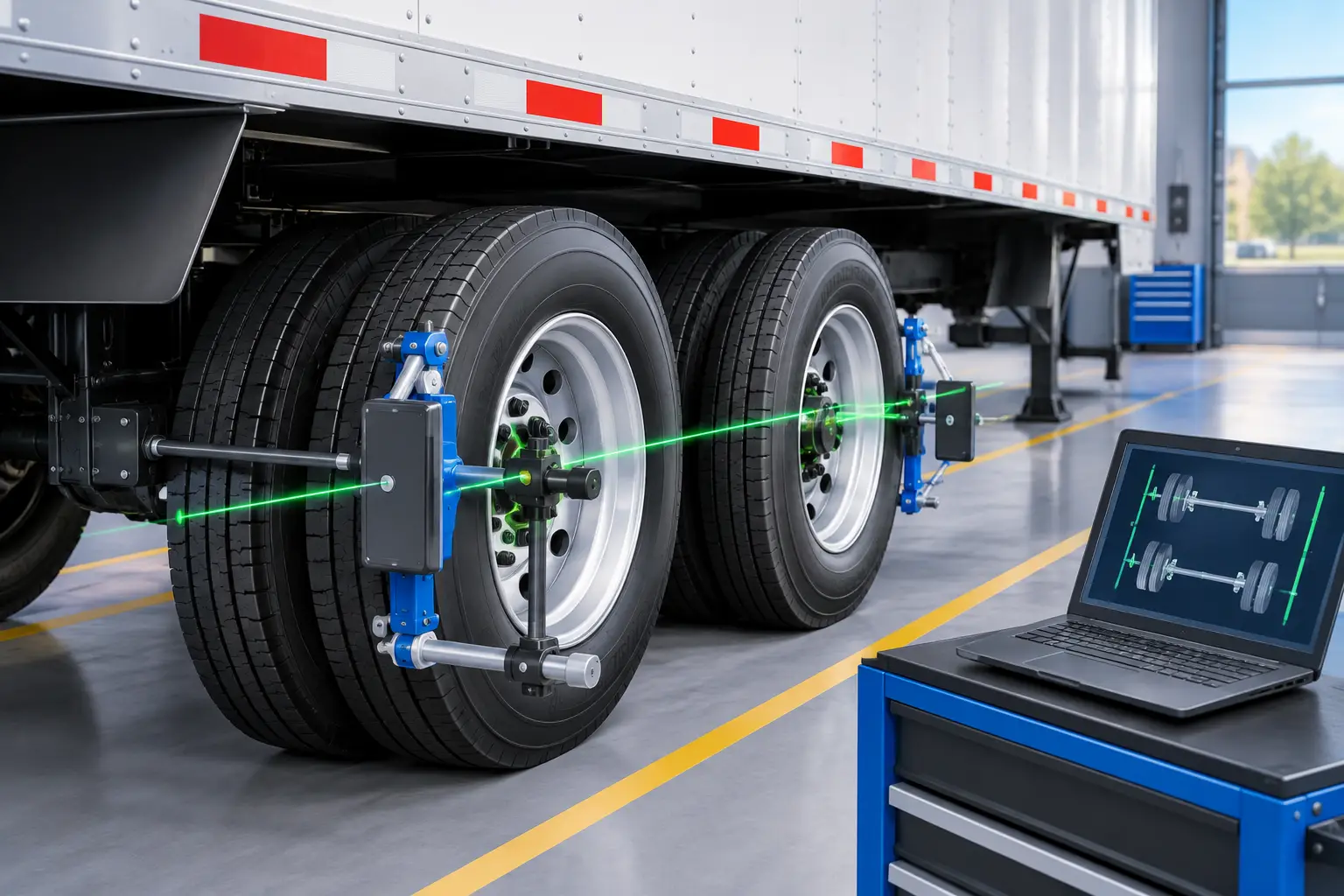
A trailer that pulls slightly to one side can wear out a set of tires long before anyone notices a handling problem. Commercial trailer axle alignment addresses the geometry behind that wear, helping trailers track straight behind the truck and carry loads as intended. For fleets that run daily routes, job-site deliveries, or heavy equipment, correcting alignment early is usually far less expensive than replacing tires, suspension parts, or a damaged axle later.
What Commercial Trailer Axle Alignment Corrects
Trailer alignment is not just about making the wheels look straight. A technician measures each axle in relation to the trailer's centerline, kingpin or coupler, and the other axles. The goal is to make the axles square to the frame and parallel to one another so the trailer follows the tow vehicle without scrubbing tires across the pavement.
When an axle is out of position, each tire may be forced to travel at a slight angle. That angle creates drag, heat, and irregular tread wear. On a tandem or triple-axle trailer, one misaligned axle can affect every tire on the unit. The trailer may also dog-track, meaning it travels offset from the truck instead of directly behind it.
Alignment issues can develop after a curb strike, pothole impact, overloaded run, roadside incident, or worn suspension component. They can also appear after axle, spring, hanger, bushing, or frame repairs. A trailer does not need to be visibly bent to have an alignment problem.
Signs Your Trailer Needs Attention
Tire condition is often the first warning. Feathered tread, rapid wear on one shoulder, cupping, or one tire wearing much faster than its mate all deserve a closer inspection. Replacing the tires without finding the cause only restarts the problem.
Drivers may notice that the trailer tracks crooked in mirrors, feels unstable, or seems to pull differently than usual. A trailer that requires frequent steering correction can be affected by alignment, although truck alignment, tire pressure, load placement, and road crown should also be considered.
Other common warning signs include repeated wheel-end repairs, loose or damaged suspension hardware, shifted spring hangers, cracked welds, and unequal axle measurements. If a trailer has been involved in an impact, it is wise to inspect alignment even when it remains operable. A unit can finish the route and still be damaging tires with every mile.
Tire Wear Tells a Useful Story
Not every worn tire points to an axle problem. Low inflation commonly wears both outer shoulders. Overinflation may wear the center of the tread. A bad bearing, brake drag, or damaged wheel can create its own wear pattern.
That is why a complete inspection matters. Technicians should check tire pressures, wheel-end condition, suspension movement, ride height where applicable, axle placement, and frame condition before deciding what needs to be adjusted. The right repair depends on what caused the alignment to move in the first place.
Why Misalignment Costs More Than Tires
Tires are the obvious expense, but they are not the only cost. Tire scrub adds rolling resistance, which can increase fuel use over time. It also creates heat that shortens tire life and raises the risk of a tire failure on the road.
A trailer that does not track correctly puts extra stress on suspension components and can make maneuvering more difficult in tight yards or job sites. For a contractor hauling equipment, a delivery company running box trailers, or a transportation fleet moving freight, an unscheduled tire service call can interrupt the entire workday.
There is also the operational cost. A trailer sidelined for tires, wheel-end damage, or suspension repairs may leave a crew without equipment, delay a delivery, or force a vehicle out of service. Alignment is preventive maintenance because it protects both the trailer and the schedule built around it.
How Commercial Trailer Axle Alignment Is Performed
Proper alignment starts with inspection and measurement, not adjustment. The trailer should be parked on a reasonably level surface, unloaded or loaded according to the service procedure, and secured safely. Technicians inspect the frame, crossmembers, suspension hangers, leaf springs or air suspension components, bushings, U-bolts, wheels, and tires.
Measurements establish whether the axle ends are equal distances from the trailer reference point and whether multiple axles are parallel. Depending on the trailer and equipment available, this may involve precision measuring tools or an electronic alignment system. The process identifies thrust angle, axle skew, and offset that may not be visible by eye.
Adjustment methods depend on the suspension design. Some trailers use adjustable torque arms, eccentric alignment hardware, or sliding suspension components. Others may require repositioning hangers, repairing damaged brackets, replacing worn components, or correcting a bent axle. On a leaf-spring trailer, loose or damaged center pins, worn bushings, and shifted springs can contribute to axle position problems.
After adjustments, measurements should be verified again. A good repair also includes checking torque on applicable fasteners and confirming that the underlying cause has been corrected. Adjusting an axle without repairing a loose hanger or worn suspension bushing can lead to the same problem returning quickly.
When Alignment Is Not the First Repair
An alignment cannot fix a cracked frame, severely bent axle tube, damaged spindle, or collapsed suspension component. Those failures need repair or replacement before final measurements mean anything. In some cases, the safest and most cost-effective decision is to replace the damaged part rather than try to compensate for it with adjustments.
This is where accurate diagnosis protects fleet budgets. A quick adjustment may appear cheaper, but it is not a solution if the trailer cannot hold alignment under load. The goal is stable, repeatable tracking, not simply getting numbers close enough for the day.
Mobile Service Versus Shop Repair
Many alignment-related inspections and suspension repairs can be handled at a fleet yard, job site, or other safe location with the right equipment and working conditions. Mobile service is especially useful when a trailer has a tire-wear concern, loose suspension hardware, or a repair that would otherwise require taking the unit out of service for a full day.
However, not every trailer is a mobile alignment candidate. A heavily damaged frame, major axle replacement, extensive welding, or a unit needing a specialized alignment rack may need a shop environment. Surface conditions, trailer access, loading, and the extent of damage all affect what can be done safely on-site.
For fleets across the Florida Panhandle, an early mobile inspection can still save time by determining whether the trailer can be repaired where it sits or needs to be moved for more extensive work. That clarity helps dispatch make the next decision quickly instead of losing time to guesswork.
Preventing Repeat Alignment Problems
Alignment checks should be part of the response to abnormal tire wear, a hard impact, suspension repairs, or recurring tracking complaints. They are also worthwhile during scheduled fleet inspections for trailers that run high mileage, carry heavy loads, or travel rough job-site roads.
Drivers and technicians can help prevent costly damage by checking tire pressure before runs, watching for uneven wear, inspecting suspension hardware, and avoiding overload conditions. Load distribution matters as well. A consistently overloaded or poorly balanced trailer places more strain on tires, springs, bushings, and axle components.
Record the work performed, tire positions, measured wear, and any alignment corrections. For a fleet with several trailers, those records make it easier to spot a unit that keeps returning with the same issue. Repeated tire damage is a maintenance signal, not a normal cost of doing business.
A trailer that tracks straight protects tires, reduces strain on components, and lets drivers focus on the road instead of fighting the equipment. When the first signs of irregular wear show up, schedule an inspection before a small alignment issue becomes a roadside repair.
